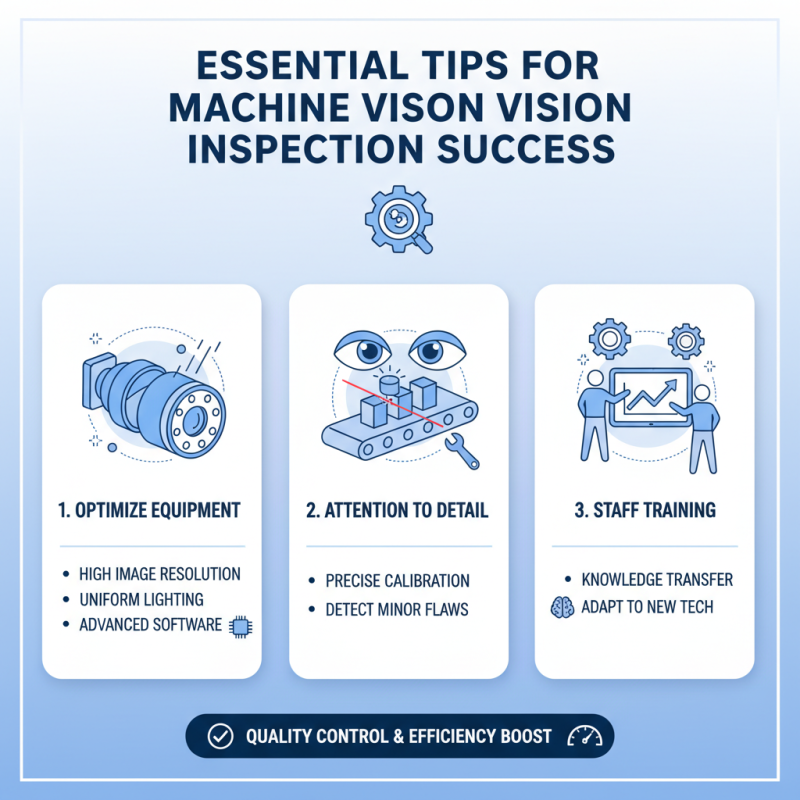
Essential Tips for Machine Vision Inspection Success?
Machine Vision Inspection is transforming industries. This technology enhances quality control and increases efficiency. Implementing effective Machine Vision Inspection can be challenging.
Choosing the right equipment is critical. Image resolution, lighting, and software play significant roles. Inadequate setup can lead to errors. Inspectors often overlook minor details, which can cause bigger issues.
Training staff is another essential factor. Knowledge gaps can hinder success. A well-trained team can adapt to changes and technology advancements. Machine Vision Inspection promises great benefits, but success requires attention to detail and continuous improvement.
Understanding Machine Vision: Key Components for Effective Inspection
Machine vision systems play a crucial role in modern manufacturing. These systems help improve quality control and increase efficiency. Understanding their key components is essential for effective inspection.
Lighting is one of the most critical aspects. Proper lighting enhances image quality. According to a report by the Automation Research Corporation, adequate lighting can boost inspection accuracy by over 30%. Experimenting with different light sources can yield better results. For instance, LED lights may highlight surface defects while backlighting can reveal edge contours.
Camera resolution is equally important. High-resolution cameras provide clearer images, allowing for more detailed analysis. A study from the International Journal of Advanced Manufacturing Technology indicates that using higher resolution cameras can reduce missed defects by approximately 25%. Choose cameras that fit your inspection needs precisely.
Another essential component is image processing software. Advanced algorithms analyze images and identify defects. However, relying solely on software can lead to oversight. Regular manual checks can prevent errors. A balanced approach combines automation with human insight to ensure thorough inspection.
Essential Tips for Machine Vision Inspection Success
| Component | Description | Importance | Tip |
| Lighting | Proper lighting ensures optimal image capture. | High | Use diffuse lighting to minimize shadows. |
| Camera | The eyes of the system, capturing images for analysis. | Critical | Choose a camera with appropriate resolution for your needs. |
| Software | Processes images and analyzes data. | Essential | Select software that fits your inspection criteria. |
| Lens | Focuses light onto the camera sensor. | Moderate | Use a lens suitable for the object distance and size. |
| Calibration | Ensures measurement accuracy. | Very High | Regularly calibrate your system to maintain accuracy. |
Data Accuracy in Machine Vision: Importance of Calibration and Testing
Calibration and testing are crucial in machine vision systems. They ensure data accuracy, which is essential for reliable inspection results. Without proper calibration, even the best hardware can produce faulty outcomes. This can lead to costly mistakes in production lines. Every component should be verified regularly. Small errors can compound over time, causing significant quality issues.
Calibration involves adjusting the vision system to recognize and measure target features accurately. It is not a one-time task. Regular testing helps identify any drift in performance. An operator might overlook a minor miscalibration. This can result in missed defects or false positives. Each inspection should be treated with care.
Testing your setup under different conditions is also key. Varying light levels or surface textures can affect results. Observing these variables informs adjustments needed for optimal performance. Regular review promotes continuous improvement. Reflection on previous inspections can highlight areas for enhancement. The aim is for consistent, accurate data that drives better decision-making.
Implementing Machine Learning for Enhanced Inspection Outcomes
Incorporating machine learning into machine vision inspection can significantly improve your outcomes. The integration of advanced algorithms allows for smarter decision-making. Machines can learn from past data, optimizing their inspection processes over time. However, success hinges on data quality. Poor data leads to flawed insights, which could result in incorrect assessments.
Here are some essential tips. Ensure proper data collection practices. Collect diverse samples to train your models effectively. Focus on different scenarios, angles, and lighting conditions. Second, regularly update your machine learning models. This keeps the system agile. Outdated models can hinder performance. Lastly, involve human inspectors in the loop. Their insight can identify areas where machines might struggle.
Challenges exist. For example, training data can be limited. Gathering enough representative samples may take time. Not every defect is easy to recognize by a machine. Reflection on these challenges can guide better practices. Balancing machine efficiency with human oversight is crucial for success.
Evaluating Lighting Techniques: Impact on Image Quality and Inspection
Lighting plays a critical role in machine vision inspection. It directly affects image quality and determination accuracy. According to a recent industry report, 80% of image quality issues stem from improper lighting. This showcases how essential it is to use the right lighting techniques.
Different lighting techniques can create varied impacts on image acquisition. For example, diffuse lighting helps minimize shadows, making features easier to detect. However, it may wash out color details, leading to potential misinterpretation. An alternative, backlighting, can enhance edge detection but might obscure object details. It’s essential to consider these trade-offs.
In practice, many systems fail to assess lighting before inspection. Inadequate evaluation can lead to faulty inspections. For instance, a study highlighted that 30% of detection errors are due to poor lighting choices. Regularly reviewing and adapting lighting setups is necessary for success. Operators must reflect on their methodologies to improve outcomes.
Essential Tips for Machine Vision Inspection Success
Integrating Machine Vision with Automation: Boosting Efficiency and Consistency
Integrating machine vision technology with automation processes is a game changer. A recent study shows that fully automated inspection systems can reduce errors by up to 70%. This integration enables faster production speeds without sacrificing quality. Companies adopting these systems see a notable reduction in inspection times, leading to significant operational savings.
However, the implementation is not without challenges. Many organizations struggle with the compatibility of existing equipment. Additionally, staff training may lag behind technological advancements. A report from an industry expert indicates that nearly 50% of companies encounter difficulties in staff adaptation to new technologies. Addressing these gaps is essential for maximizing efficiency.
Visual data analytics plays a critical role in the integration process. Real-time analysis provides actionable insights, but it requires robust software. Some companies report issues with software limitations. They struggle to analyze large datasets effectively. This can slow down the production line. Investing in the right technology and training is crucial for overcoming these obstacles and achieving true automation success.